Paint Correction Explained: Swirls, Scratches and the Mirror Finish
By JX Auto Lab
There's a moment every North Dallas driver knows. You pull out of the garage, the morning sun comes over the rooftops, and your hood lights up with a web of fine circular scratches you swear weren't there before. They were. You're just finally seeing them.
Those are swirl marks, and they are the single most common reason a well-kept car still looks dull. The good news: they live in your clear coat, not your color, and that means they can be corrected. This is what paint correction actually does, and why it's one of the most transformative things you can do for a vehicle in the DFW climate.
What's Actually Happening to Your Paint
Modern automotive paint is layered. On top of the colored basecoat sits a thin, clear protective layer called the clear coat. Nearly every imperfection you notice day to day lives in that clear layer, not the paint underneath.
- Swirl marks, fine, spiderweb scratches, almost always from improper washing. Automatic car washes with stiff brushes, dirty wash mitts, and dry "wiping down" are the usual culprits.
- Scratches, deeper, isolated lines from keys, branches, road debris, or careless contact.
- Water spots, and in Texas this is a big one. Our hard water is heavy with dissolved minerals. Sprinklers, hose-downs in the driveway, and rain that dries in the sun leave mineral deposits that bond to the clear coat and etch it.
- Oxidation and haze, relentless Texas sun slowly breaks down the surface, flattening the gloss and graying the finish.
DFW is genuinely hard on paint. Between the UV load, the hard water, highway grit off the Dallas North Tollway and 121, pollen season coating everything in yellow, and bug and tar splatter in summer, your clear coat takes a beating from every direction.
What Paint Correction Really Is
Here's the part people misunderstand. Paint correction is not a wax, a polish-and-pray, or a product you spray on to hide flaws. Correction physically removes a microscopic layer of clear coat to level the surface down to the bottom of the defects, so light reflects evenly instead of scattering off thousands of tiny scratch walls.
It's done with a dual-action or rotary polisher, graded cutting and finishing compounds, and the right pads, all matched to your specific paint's hardness. Done correctly, the swirls don't come back, because they're gone, not filled.
This is also why correction is skill-dependent, not product-dependent. Clear coat is finite. Aggressive or careless polishing thins it permanently. The craft is removing exactly enough to eliminate the defect and not a micron more.
One-Step vs. Full Correction
Not every car needs the same level of work, which is why JX Auto Lab offers two tiers.
- 1-Step Paint Enhancement, a single corrective polishing stage. It removes a strong majority of light to moderate swirls and dramatically boosts gloss in one pass. Ideal for newer vehicles, leased cars, or daily drivers that have been reasonably cared for and just need their depth restored.
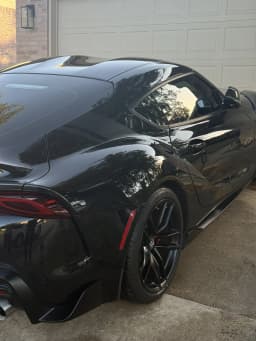
- Full Paint Correction, a multi-stage process: cutting to remove deeper defects, then refining steps to bring the finish to maximum clarity. This is the route to a true mirror finish, where reflections are sharp and undistorted. Best for darker colors that show everything, neglected paint, or anyone chasing a show-quality result.
The honest answer for your specific car comes from inspecting the paint in person under proper lighting. Owner Jordan Rodriguez evaluates the clear coat before recommending a tier, no upselling you into stages your paint doesn't need.
Why Correction Comes Before Coating
If you're considering a ceramic coating, correction isn't optional, it's the foundation. A coating is optically clear and permanent for years. Whatever the paint looks like underneath, the coating locks in. Seal swirls under a 3-to-5-year ceramic and you've preserved the flaws.
That's why the right sequence is always: correct first, then protect. Once the paint is leveled and flawless, a ceramic coating (Standard, 2-3 years, or Premium, 3-5 years) shields that finish from the UV, hard water spotting, and contaminants that caused the damage in the first place. It also makes future washing far gentler, which means the swirls are far less likely to return.
Keeping the Mirror Finish
Correction resets your paint. Protecting that reset is on the maintenance side.
- Skip the brush-style automatic washes that caused the swirls.
- Don't let sprinklers or hard water dry on the surface in the sun.
- Rinse off pollen and highway grime before it sits and bonds.
- Pair correction with a ceramic coating for the longest-lasting result.
A corrected, coated vehicle in North Dallas doesn't just look better in the driveway, it photographs better, holds resale value better, and stays cleaner between washes.
Ready to See What's Under the Swirls
If your paint looks tired, hazy or cobwebbed in the sun, request a paint assessment. JX Auto Lab takes requests in Fort Worth and nearby service areas; North Dallas locations receive a travel review. Jordan checks the paint condition and proposed worksite, including space, permission, water and power arrangements, before agreeing to correction work.
Book a mobile detail with JX Auto Lab, and let's take a look at what your paint can really do.